
The sound is unmistakable—a sudden rush of water where it shouldn't be, followed by the sinking realization that somewhere in your walls, ceiling, or basement, a pipe has burst. In the North Okanagan's harsh winters, burst pipes are one of the most common and destructive home emergencies we respond to at Total Restoration Services.
Here's the truth: the first 30 minutes after a pipe bursts are critical. The actions you take in those crucial moments can mean the difference between minor water damage and a catastrophic loss that costs tens of thousands of dollars.
Having responded to a LOT of burst pipe emergencies across the North Okanagan, we've seen homeowners handle these situations brilliantly—and we've seen costly mistakes that could have been avoided. This guide will walk you through exactly what to do when disaster strikes.
Step 1: Shut Off the Water IMMEDIATELY (30 seconds)
Do this before anything else—even before calling anyone.
Locate your main water shut-off valve and turn it clockwise to close it. In most North Okanagan homes, you'll find it:
- Near where the water line enters your home (often in the basement)
- In a utility room or mechanical room
- Sometimes in a crawl space or outside meter box
If you don't know where your main shut-off is, find it RIGHT NOW—before an emergency happens. Label it clearly so anyone in your household can locate it quickly.
Pro tip: If the burst is isolated to one fixture (like under a sink), you may be able to shut off just that fixture's supply valve instead of the entire house. But when in doubt, shut off the main.
Step 2: Turn Off Your Electricity (1 minute)
If water is flowing near electrical outlets, appliances, or your electrical panel, cut the power immediately.
- If you can safely reach your electrical panel without walking through water, turn off power to affected areas
- If water is near the panel itself or you'd have to wade through water to reach it, do not approach it—evacuate and call 911
Water and electricity are a deadly combination. Your safety is more important than your belongings.
Step 3: Call Total Restoration Services—24/7 Emergency Response (2 minutes) 250-545-1527
Once the water is shut off and you're safe, call us immediately. Here's why the call matters right now, not later:
- Water damage accelerates exponentially. Every hour of delay increases damage and restoration costs
- We work directly with your insurance company and can begin documentation immediately
- We provide emergency mitigation to prevent secondary damage like mold growth
- Our team can arrive within hours, equipped to extract water and begin drying
When you call, we'll ask you:
- Where the burst occurred
- How long water has been flowing
- What areas are affected
- Whether power is still on in wet areas
Don't worry about cleaning up before we arrive—we need to see the full extent of damage for proper documentation and insurance purposes.
Step 4: Document Everything (10 minutes)
Before touching anything, document the damage for your insurance claim:
- Take photos and videos of all affected areas from multiple angles
- Capture the source of the leak if visible
- Document water levels, wet materials, and damaged belongings
- Take photos of any valuable items that are damaged
- Note the date and time the burst occurred
This documentation is crucial for your insurance claim and helps us develop an accurate restoration plan.
Step 5: Remove Standing Water (If Safe)
Only if you can do so safely and while waiting for professional help:
- Use a wet/dry vacuum to remove standing water from hard surfaces
- Place buckets under active drips
- Move furniture and belongings away from wet areas if possible
- Place aluminum foil or plastic under furniture legs sitting in damp carpet
Do NOT attempt to remove water if:
- It's contaminated (from sewage or flooding)
- Electrical hazards are present
- Structural damage is visible
- The volume is overwhelming
- Leave major water extraction to the professionals—we have industrial equipment that removes water far more effectively than household tools.
Step 6: Promote Air Circulation
While waiting for our team to arrive:
- Open windows (if outdoor temperature permits)
- Turn on fans to circulate air
- Turn up the heat slightly to aid evaporation
- Remove wet rugs, towels, and fabrics to dry areas
Do NOT use your furnace or HVAC if water has affected ductwork or electrical components.
Step 7: Salvage What You Can
Time-sensitive items that should be addressed immediately:
- Move books, photos, and documents to dry areas and lay them flat to dry
- Remove wet cushions from furniture and stand them on end
- Hang wet clothing and fabrics to dry
- Wipe down wet wood furniture with towels
- Remove paintings and artwork from wet walls
Leave in place:
- Built-in cabinetry and fixtures
- Drywall and structural materials (we assess these)
- Flooring (we determine what can be saved)
- Anything electrical or mechanically damaged
What NOT to Do During a Pipe Burst Emergency
We've seen these mistakes cause additional damage or safety hazards:
❌ Don't use regular household vacuums on standing water (risk of electrical shock)
❌ Don't enter flooded areas without checking for electrical hazards
❌ Don't turn on ceiling fans if the ceiling is wet (risk of electrical fire or collapse)
❌ Don't use heat guns or high heat to dry materials (can cause warping and cracking)
❌ Don't delay calling professionals to save money—delay costs far more in the long run
❌ Don't throw away damaged items before documenting them for insurance
After the Emergency: The Restoration Process
Once our Total Restoration Services team arrives, here's what happens:
Immediate Response (Hours 1-4):
- Complete damage assessment and moisture mapping
- Emergency water extraction with industrial equipment
- Removal of unsalvageable materials
- Placement of commercial dehumidifiers and air movers
- Documentation for insurance claims
Drying Phase (Days 1-5):
- Continuous monitoring of moisture levels
- Adjustment of drying equipment
- Daily progress reports
- Coordination with insurance adjusters
Restoration Phase (Week 2+):
- Repair of damaged pipes
- Replacement of drywall, insulation, flooring
- Painting and finishing
- Complete restoration to pre-loss condition
Understanding Your Insurance Coverage
Most homeowner policies cover sudden and accidental water damage from burst pipes, but understanding your coverage is critical:
Typically Covered:
- Water damage from burst pipes due to freezing
- Emergency mitigation and restoration costs
- Temporary housing if your home is uninhabitable
Often NOT Covered:
- Gradual leaks or maintenance-related failures
- Damage if home was vacant and heat wasn't maintained
- The cost of repairing the pipe itself (though damage caused by the pipe is covered)
Our team works directly with your insurance company to ensure you receive the coverage you're entitled to. We handle documentation, communicate with adjusters, and provide detailed scoping so you can focus on getting your life back to normal.
Prevention
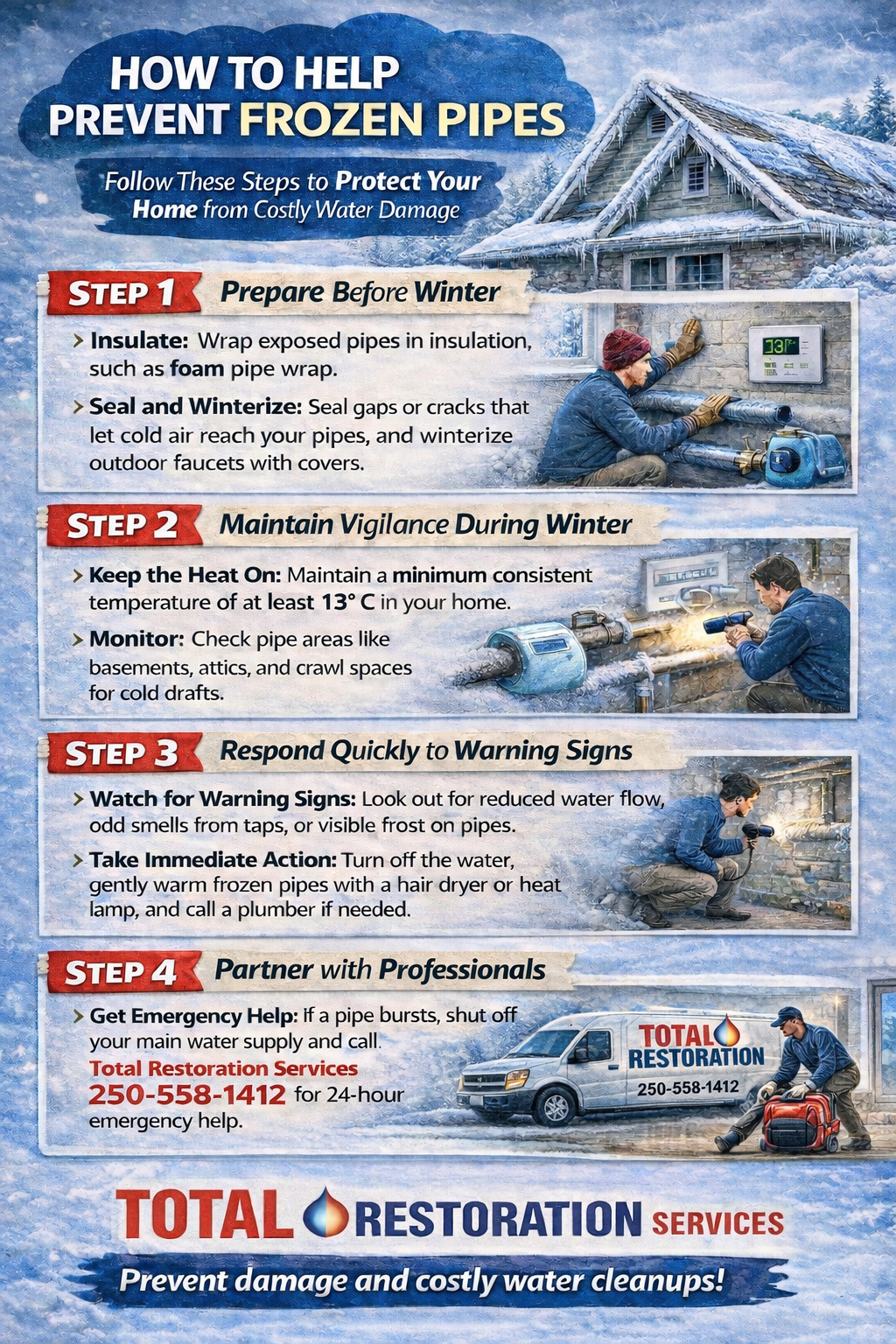
The best way to handle a burst pipe is to prevent it from happening. In the North Okanagan, where winter temperatures regularly plunge below -20°C, prevention is critical:
- Maintain home temperature at minimum 13°C, even when away
- Insulate exposed pipes in crawl spaces, attics, and exterior walls
- Let faucets drip during extreme cold snaps
- Open cabinet doors to allow warm air circulation around pipes
- Have someone check your home daily if you're away during winter
You're Not Alone in This Emergency
A burst pipe feels overwhelming, but you don't have to face it alone. Our team has guided hundreds of North Okanagan homeowners through this exact crisis, and we'll guide you too.
When disaster strikes, we answer the phone, we respond quickly, we work with your insurance company, and we restore your home to the place it was before—or better.
Have questions about water damage or emergency preparedness? Contact us today—we're happy to help, even before an emergency happens.